Brandwatch strength
An enterprise social intelligence and consumer research platform designed for broad listening, analytics, and cross-team reporting.
Find a Brandwatch alternative built for startups that need recommendation requests, competitor complaints, and public buying intent without enterprise overhead.
Startups rarely need the full weight of an enterprise listening suite. This page helps them decide when a smaller, higher-intent workflow beats a broader intelligence stack.
An enterprise social intelligence and consumer research platform designed for broad listening, analytics, and cross-team reporting.
ReplyRadar fits startups that want founder-usable monitoring without enterprise setup, broad reporting overhead, or a lot of post-alert triage.
This page is written for lean startup teams comparing Brandwatch with a smaller, more selective ReplyRadar workflow.
The competitor can still make sense if the startup needs its specific specialty badly enough to justify extra complexity or a different operating model.
The goal of this page is not to claim ReplyRadar replaces every enterprise social intelligence workflow. It is to show where a founder-led team needs a lighter, more selective way to find and qualify public demand.
Founder-led or lean GTM teams that mainly need a smaller stream of high-intent conversations instead of a broad intelligence program.
ReplyRadar stays lighter, more action-oriented, and better aligned to recommendation requests, complaints, and reply-worthy public demand.
Brandwatch makes more sense when the buyer primarily wants broad social intelligence, reporting, trend analysis, and cross-functional listening workflows. ReplyRadar makes more sense when the buyer wants founder-usable demand capture tied to live public conversations.
| Category | ReplyRadar | Brandwatch |
|---|---|---|
| Primary job | Find recommendation requests, complaint-heavy threads, and public buying-intent conversations worth a manual reply. | Broad social intelligence, reporting, trend analysis, and cross-functional listening workflows. |
| Best for | Founders and lean GTM teams that want a smaller queue with clearer reasons why each thread matters. | Larger teams that need deep listening, reporting, and consumer-intelligence workflows across many channels and stakeholders. |
| Signal emphasis | Recommendation language, alternatives, competitor complaints, urgency, and audience fit. | Strong for breadth, reporting, and enterprise social intelligence. |
| Coverage model | Selective public-conversation discovery oriented around action and manual participation. | Wide listening coverage built for enterprise intelligence use cases more than founder-grade opportunity review. |
| Team fit | Best when a founder or small team wants to keep the workflow operator-friendly and low-noise. | Best for larger organizations with dedicated social, insight, or research ownership. |
| Why buyers switch | ReplyRadar stays lighter, more action-oriented, and better aligned to recommendation requests, complaints, and reply-worthy public demand. | Founder-led or lean GTM teams that mainly need a smaller stream of high-intent conversations instead of a broad intelligence program. |
ReplyRadar: Designed for teams that want a smaller, more selective public-conversation workflow.
Brandwatch: Enterprise pricing with contact-sales packaging.
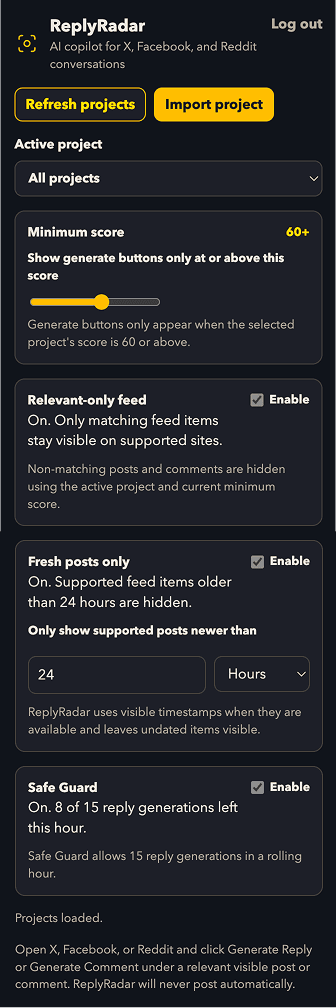
ReplyRadar keeps the qualification and drafting workflow close to the live public conversation so founders can decide whether to act quickly.
This section explains how Brandwatch and ReplyRadar differ on startup buying context so the buyer can choose the sharper workflow with less guesswork.
Larger teams that need deep listening, reporting, and consumer-intelligence workflows across many channels and stakeholders.
ReplyRadar stays lighter, more action-oriented, and better aligned to recommendation requests, complaints, and reply-worthy public demand.
If your team aligns more with Brandwatch's native workflow, choose Brandwatch. If you mainly want selective public-conversation discovery with less manual triage, choose ReplyRadar.
This section explains how Brandwatch and ReplyRadar differ on where brandwatch fits so the buyer can choose the sharper workflow with less guesswork.
Larger teams that need deep listening, reporting, and consumer-intelligence workflows across many channels and stakeholders.
ReplyRadar stays lighter, more action-oriented, and better aligned to recommendation requests, complaints, and reply-worthy public demand.
If your team aligns more with Brandwatch's native workflow, choose Brandwatch. If you mainly want selective public-conversation discovery with less manual triage, choose ReplyRadar.
This section explains how Brandwatch and ReplyRadar differ on why startups overbuy listening suites so the buyer can choose the sharper workflow with less guesswork.
Larger teams that need deep listening, reporting, and consumer-intelligence workflows across many channels and stakeholders.
ReplyRadar stays lighter, more action-oriented, and better aligned to recommendation requests, complaints, and reply-worthy public demand.
If your team aligns more with Brandwatch's native workflow, choose Brandwatch. If you mainly want selective public-conversation discovery with less manual triage, choose ReplyRadar.
The day-to-day workflow is where these tools usually diverge most. This section compares how a team actually moves from discovery to judgment to participation.
Broad social intelligence, reporting, trend analysis, and cross-functional listening workflows.
ReplyRadar is built around a smaller loop: discover, qualify, decide, and draft a useful manual response when the fit is real.
Choose the workflow that matches the real next step after discovery. If the next step is participation, ReplyRadar usually has the better shape.
This section explains how Brandwatch and ReplyRadar differ on time-to-value so the buyer can choose the sharper workflow with less guesswork.
Larger teams that need deep listening, reporting, and consumer-intelligence workflows across many channels and stakeholders.
ReplyRadar stays lighter, more action-oriented, and better aligned to recommendation requests, complaints, and reply-worthy public demand.
If your team aligns more with Brandwatch's native workflow, choose Brandwatch. If you mainly want selective public-conversation discovery with less manual triage, choose ReplyRadar.
This section gives the shortest decision rule for brandwatch alternative for startups. Brandwatch and ReplyRadar overlap, but they create value at different moments in the workflow.
Larger teams that need deep listening, reporting, and consumer-intelligence workflows across many channels and stakeholders.
ReplyRadar stays lighter, more action-oriented, and better aligned to recommendation requests, complaints, and reply-worthy public demand.
If your team aligns more with Brandwatch's native workflow, choose Brandwatch. If you mainly want selective public-conversation discovery with less manual triage, choose ReplyRadar.
The right tool is the one your team will actually keep using. If you mainly want high-intent public conversations with less manual triage, ReplyRadar is the sharper test.
Brandwatch can be overkill when the team mainly wants a small, founder-usable workflow for public conversations. It usually makes more sense when the broader platform assumptions actually match the team's needs.
Brandwatch and ReplyRadar overlap, but they are optimized for different jobs. The right choice depends on whether the buyer needs enterprise social intelligence depth or ReplyRadar's more selective public-conversation workflow.
Brandwatch and ReplyRadar overlap, but they are optimized for different jobs. The right choice depends on whether the buyer needs enterprise social intelligence depth or ReplyRadar's more selective public-conversation workflow.
Browse the full set of ReplyRadar alternative and vs pages organized around buying-intent discovery.
Use the evergreen intent pages when the buyer still needs category education before choosing a workflow or vendor.
Connect vendor evaluation pages to fresh switching-language and complaint-heavy report coverage.
Show what a stronger conversation-discovery workflow looks like with product-led opportunity examples.
See the direct vendor comparison for Brandwatch and ReplyRadar.
See how ReplyRadar frames recommendation requests, switching language, and public evaluation behavior.
Show what a more selective public-conversation workflow looks like in practice.
See how ReplyRadar tries to reduce low-quality matches before a founder opens the thread.
Use ReplyRadar to monitor Reddit and X for recommendation requests, competitor complaints, and real workflow pain points that deserve a thoughtful reply.