Common Room strength
A buyer-intelligence platform that captures signals across many first-, second-, and third-party sources, then enriches them for larger GTM workflows.
Compare Common Room with a lighter ReplyRadar workflow for founders who want buying-intent discovery without an enterprise GTM stack.
Common Room is a serious buyer-intelligence platform. ReplyRadar is a tighter workflow for founders who want public recommendation requests, competitor complaints, and live evaluation conversations without a full revenue-ops layer.
A buyer-intelligence platform that captures signals across many first-, second-, and third-party sources, then enriches them for larger GTM workflows.
ReplyRadar is usually the stronger fit when the buyer wants a tighter queue of recommendation requests, complaints, and high-intent discussions rather than a wider monitoring surface.
This page is written for teams comparing vendors at a category level comparing Common Room with a smaller, more selective ReplyRadar workflow.
The competitor is usually stronger when the team wants the category's native workflow more than ReplyRadar's high-intent, reply-first workflow.
The goal of this page is not to claim ReplyRadar replaces every buyer intelligence workflow. It is to show where a founder-led team needs a lighter, more selective way to find and qualify public demand.
Founder-scale teams that mostly want public conversation discovery without a larger sales-ops layer.
ReplyRadar stays lighter, more public-conversation-native, and easier to operate without a full sales stack.
Common Room makes more sense when the buyer primarily wants broad signal capture, enrichment, segmentation, and revenue workflow orchestration. ReplyRadar makes more sense when the buyer wants founder-usable demand capture tied to live public conversations.
| Category | ReplyRadar | Common Room |
|---|---|---|
| Primary job | Find recommendation requests, complaint-heavy threads, and public buying-intent conversations worth a manual reply. | Broad signal capture, enrichment, segmentation, and revenue workflow orchestration. |
| Best for | Founders and lean GTM teams that want a smaller queue with clearer reasons why each thread matters. | Revenue teams that need signal capture, enrichment, CRM alignment, and multi-seat GTM execution. |
| Signal emphasis | Recommendation language, alternatives, competitor complaints, urgency, and audience fit. | Strong for enriched buying signals, account context, and larger GTM motions. |
| Coverage model | Selective public-conversation discovery oriented around action and manual participation. | Wide buyer-signal coverage with heavier account and person context than a founder typically needs at the start. |
| Team fit | Best when a founder or small team wants to keep the workflow operator-friendly and low-noise. | Best for larger or more mature GTM teams, not for the lightest founder-led workflow. |
| Why buyers switch | ReplyRadar stays lighter, more public-conversation-native, and easier to operate without a full sales stack. | Founder-scale teams that mostly want public conversation discovery without a larger sales-ops layer. |
ReplyRadar: Designed for teams that want a smaller, more selective public-conversation workflow.
Common Room: Starts at $2,100/month for Essential and scales into custom plans.
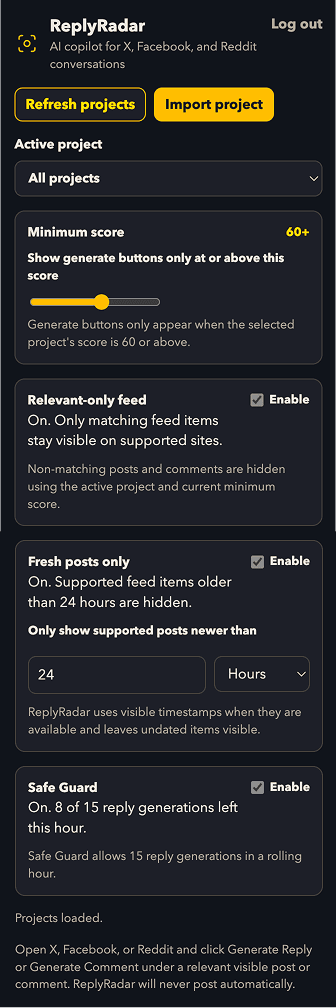
ReplyRadar keeps the qualification and drafting workflow close to the live public conversation so founders can decide whether to act quickly.
This section gives the shortest decision rule for common room alternative. Common Room and ReplyRadar overlap, but they create value at different moments in the workflow.
Revenue teams that need signal capture, enrichment, CRM alignment, and multi-seat GTM execution.
ReplyRadar stays lighter, more public-conversation-native, and easier to operate without a full sales stack.
If your team aligns more with Common Room's native workflow, choose Common Room. If you mainly want selective public-conversation discovery with less manual triage, choose ReplyRadar.
This section explains how Common Room and ReplyRadar differ on who common room is for so the buyer can choose the sharper workflow with less guesswork.
Revenue teams that need signal capture, enrichment, CRM alignment, and multi-seat GTM execution.
ReplyRadar stays lighter, more public-conversation-native, and easier to operate without a full sales stack.
If your team aligns more with Common Room's native workflow, choose Common Room. If you mainly want selective public-conversation discovery with less manual triage, choose ReplyRadar.
This section compares where each tool gets signal, how broad the capture surface is, and whether that broader coverage actually helps the buyer solve the job behind common room alternative.
Wide buyer-signal coverage with heavier account and person context than a founder typically needs at the start.
ReplyRadar is more comfortable missing low-value mentions if it means the remaining queue is easier to trust and act on.
Choose Common Room if broader source capture is the real requirement. Choose ReplyRadar if selective public-conversation action matters more.
The day-to-day workflow is where these tools usually diverge most. This section compares how a team actually moves from discovery to judgment to participation.
Broad signal capture, enrichment, segmentation, and revenue workflow orchestration.
ReplyRadar is built around a smaller loop: discover, qualify, decide, and draft a useful manual response when the fit is real.
Choose the workflow that matches the real next step after discovery. If the next step is participation, ReplyRadar usually has the better shape.
Pricing is only useful when read next to workflow fit. This section compares the cost shape, operating assumptions, and team complexity behind Common Room and ReplyRadar.
Starts at $2,100/month for Essential and scales into custom plans.
ReplyRadar is designed to feel smaller and easier to justify when the team mainly wants high-intent public-conversation discovery.
Choose the tool whose daily workflow your team will actually maintain. The wrong process is expensive even when the subscription is not.
This section explains how Common Room and ReplyRadar differ on best choice by use case so the buyer can choose the sharper workflow with less guesswork.
Revenue teams that need signal capture, enrichment, CRM alignment, and multi-seat GTM execution.
ReplyRadar stays lighter, more public-conversation-native, and easier to operate without a full sales stack.
If your team aligns more with Common Room's native workflow, choose Common Room. If you mainly want selective public-conversation discovery with less manual triage, choose ReplyRadar.
The right tool is the one your team will actually keep using. If you mainly want high-intent public conversations with less manual triage, ReplyRadar is the sharper test.
Common Room can be overkill when the team mainly wants a small, founder-usable workflow for public conversations. It usually makes more sense when the broader platform assumptions actually match the team's needs.
Not completely. ReplyRadar focuses on public recommendation requests, complaints, and visible buying language. It is a tighter public-signal workflow, not a full replacement for every category of intent data.
ReplyRadar is usually the better fit for founders when the job is staying close to live public conversations, keeping the queue small, and deciding manually whether to reply.
Browse the full set of ReplyRadar alternative and vs pages organized around buying-intent discovery.
Use the evergreen intent pages when the buyer still needs category education before choosing a workflow or vendor.
Connect vendor evaluation pages to fresh switching-language and complaint-heavy report coverage.
Show what a stronger conversation-discovery workflow looks like with product-led opportunity examples.
See the direct vendor comparison for Common Room and ReplyRadar.
See ReplyRadar's point of view on recommendation requests, complaints, and public evaluation language.
See the kinds of public buyer-intent conversations ReplyRadar is designed to surface.
See how ReplyRadar tries to reduce low-quality matches before a founder opens the thread.
Use ReplyRadar to monitor Reddit and X for recommendation requests, competitor complaints, and real workflow pain points that deserve a thoughtful reply.