Built for manual discovery
ReplyRadar fits founders, GTM operators, and early-stage teams who still want humans reviewing the conversation before acting.
Customer discovery gets messy when founders rely on scattered notes, broad keyword feeds, and generic monitoring. See how ReplyRadar helps founders, GTM operators, and early-stage teams find better research and manual outbound context, then start on ReplyRadar.
Problem-aware teams usually land here after realizing that interviews alone are too episodic, manual search is too noisy, and generic monitoring does not preserve the context behind what buyers actually mean. ReplyRadar helps founders and lean GTM teams keep customer discovery tied to live conversations, real pain, and manual outbound decisions that still need judgment.
ReplyRadar fits founders, GTM operators, and early-stage teams who still want humans reviewing the conversation before acting.
Track recommendation requests, complaints, and workarounds in the same words buyers use when they explain the problem.
Use the same live threads to sharpen interview questions, improve positioning, and decide whether a careful outbound follow-up is worth it.
ReplyRadar is optimized for review quality and context, not for flooding a lean team with every possible mention.
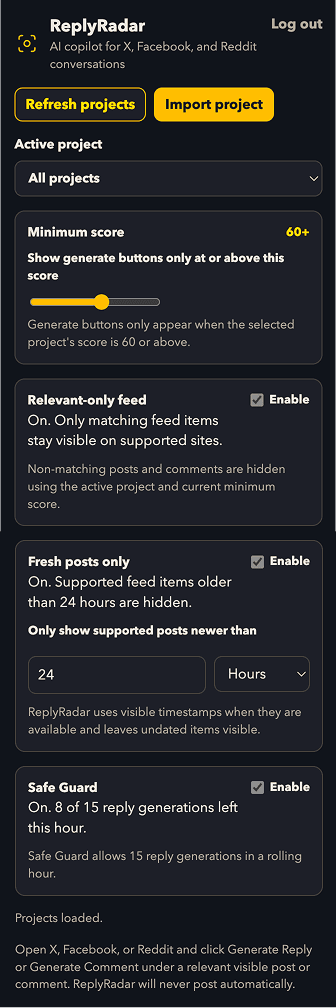
ReplyRadar keeps discovery, qualification, and reply drafting close to the live Reddit or X conversation instead of hiding the work in a generic dashboard.
Teams can review fit signals, discussion context, and reply angles before deciding whether the conversation is worth joining.
Teams doing problem-aware commercial research usually already know the category matters. The hard part is finding concrete buyer language, repeated objections, and switch-ready pain fast enough to use it. When discovery depends on broad social listening, ad hoc search, and note piles, the result is lots of reading with very little confidence about what deserves a follow-up.
Founders can find a few useful threads by hand, but they rarely keep a repeatable habit for spotting the next recommendation request, workflow complaint, or evaluation post at the right time.
Broad keyword alerts surface awareness and chatter, but they usually do not preserve the buyer context that makes a conversation useful for research or manual outbound.
The team learns something valuable from a live thread, then loses the original nuance before it becomes better messaging, a saved search update, or a careful follow-up.
The best workflows stay commercial without becoming spammy. They help the team hear real buyer language, understand who the conversation fits, and decide whether the next move is research, positioning work, or a manual outbound step.
Monitor recommendation requests, implementation friction, and workaround stories so product and GTM teams keep learning from buyers even when no interview is scheduled this week.
Use public threads to see when someone is already comparing options, frustrated with the current workflow, or describing constraints that make your product relevant before you ever draft a message.
Turn repeated objections, competitor weaknesses, and problem framing into sharper landing pages, comparison pages, and sales narratives while the language is still fresh.
Generic social listening tools often optimize for broad coverage, reporting, or awareness. ReplyRadar is built for smaller teams that need a more selective workflow. It keeps the thread context, fit signals, and next-step judgment close together so customer discovery can stay useful instead of sprawling.
Prioritize recommendation requests, competitor complaints, and problem-heavy threads instead of reviewing every category mention that happens to include a keyword.
Keep buyer language, urgency, and product-fit clues visible so the operator can decide whether the thread is best used for research, a reply, or a manual outbound follow-up.
ReplyRadar can help qualify and draft around a conversation, but it does not force customer discovery into automation that would make outreach weaker or less trustworthy.
Most objections come from real experience. Founders have tried keyword alerts, broad social monitoring, or one-off research sprints that produced notes but not a sustainable workflow.
That is still important, but public conversations fill the gaps between interviews and expose the unprompted language buyers use when they are not responding to a research script.
That concern is exactly why ReplyRadar emphasizes a smaller, more selective queue with thread-level context instead of broader monitoring for its own sake.
That is part of the fit. ReplyRadar is strongest when the team still wants humans deciding whether a thread deserves research, outreach, or simply a saved note for later positioning work.
If your team wants to validate the workflow before committing deeper, use ReplyRadar's tools and intent pages to explore the kinds of conversations that make customer discovery and manual outbound more useful.
It is the practice of using real public questions, complaints, recommendation requests, and workaround stories to understand buyer language, pain, and evaluation criteria before or between direct interviews.
Yes. The same threads that teach you what buyers care about can also reveal when a careful, context-aware follow-up might be relevant. The key is keeping the workflow selective and manual.
ReplyRadar is narrower and more commercial. It is built to help founders and lean GTM teams review stronger-fit conversations with context, not maximize mention volume or reporting dashboards.
Yes. ReplyRadar works best as a continuous discovery layer around interviews. It helps you hear more live buyer language, pressure-test assumptions, and show up to interviews with better prompts.
Start with the evergreen cluster for buying intent, recommendation monitoring, and high-intent conversation discovery.
Browse the public tool hub for lighter acquisition workflows around social listening, buying intent, and conversation review.
Review the product terms if your team wants clarity on account usage before rolling out a new monitoring workflow.
See how ReplyRadar turns noisy monitoring into a tighter workflow for customer discovery, outbound research, and high-intent conversation review.
Track public demand signals across Reddit and X before the buyer fills out a form or talks to a competitor.
Learn how to recognize and qualify social conversations that reveal active evaluation, pain, or recommendation intent.
Monitor public communities for recommendation requests, buyer language, and reply-worthy demand without falling back to noisy alert dashboards.
Focus on recommendation language, switching behavior, workflow complaints, and named competitors instead of vanity mentions.
Own the moments when buyers ask what they should use, replace, or switch to next.
See how ReplyRadar ranks recommendation posts, competitor complaints, and workflow pain against your positioning.
Understand the scoring layer behind the Reddit conversation discovery workflow.
Browse public ReplyRadar projects to see how different products frame their audience, pain points, and competitors.
Use ReplyRadar to monitor Reddit and X for recommendation requests, competitor complaints, and real workflow pain points that deserve a thoughtful reply.