Google Alerts strength
A simple keyword alerting product that emails basic matches when Google indexes relevant content.
Compare Google Alerts with ReplyRadar for founders who need recommendation requests, switch signals, and complaint monitoring instead of generic notifications.
Buying-intent discovery needs more context than a free alert can usually provide. This page helps teams decide when to move from basic notifications to a stronger signal workflow.
A simple keyword alerting product that emails basic matches when Google indexes relevant content.
ReplyRadar fits teams that care more about recommendation language, switching intent, and decision-stage timing than about coverage for its own sake.
This page is written for operators trying to catch decision-stage demand comparing Google Alerts with a smaller, more selective ReplyRadar workflow.
The competitor is stronger when buying intent is only one sub-problem inside a wider analytics, enrichment, or monitoring program.
The goal of this page is not to claim ReplyRadar replaces every simple keyword alerts workflow. It is to show where a founder-led team needs a lighter, more selective way to find and qualify public demand.
Teams that need fresher community monitoring, better prioritization, and more context around why a conversation matters.
ReplyRadar adds context, scoring, and a stronger path from public conversation to a useful founder decision.
Google Alerts makes more sense when the buyer primarily wants basic keyword notifications followed by manual review outside the product. ReplyRadar makes more sense when the buyer wants founder-usable demand capture tied to live public conversations.
| Category | ReplyRadar | Google Alerts |
|---|---|---|
| Primary job | Find recommendation requests, complaint-heavy threads, and public buying-intent conversations worth a manual reply. | Basic keyword notifications followed by manual review outside the product. |
| Best for | Founders and lean GTM teams that want a smaller queue with clearer reasons why each thread matters. | People who need free, low-friction notifications and are comfortable doing the qualification themselves. |
| Signal emphasis | Recommendation language, alternatives, competitor complaints, urgency, and audience fit. | Strong for free alerts, weak for context-rich buying-intent discovery. |
| Coverage model | Selective public-conversation discovery oriented around action and manual participation. | Broad web alerting with weaker fit for live community intent and thread-level qualification. |
| Team fit | Best when a founder or small team wants to keep the workflow operator-friendly and low-noise. | Best for the lightest monitoring use cases where budget matters more than signal quality. |
| Why buyers switch | ReplyRadar adds context, scoring, and a stronger path from public conversation to a useful founder decision. | Teams that need fresher community monitoring, better prioritization, and more context around why a conversation matters. |
ReplyRadar: Designed for teams that want a smaller, more selective public-conversation workflow.
Google Alerts: Free.
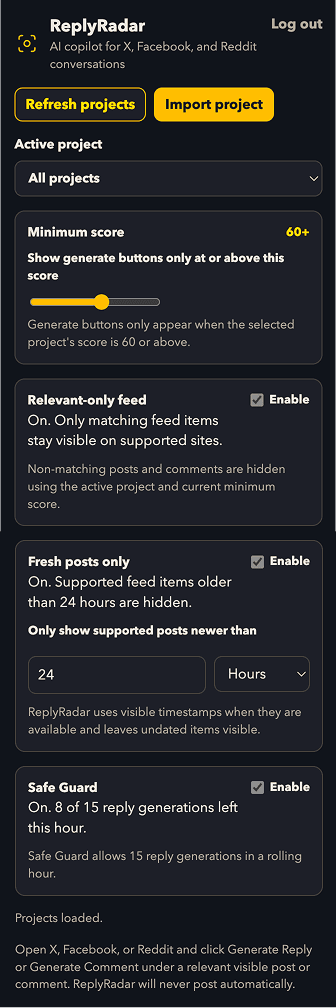
ReplyRadar keeps the qualification and drafting workflow close to the live public conversation so founders can decide whether to act quickly.
Buying-intent monitoring is not the same as broad monitoring. This section focuses on recommendation language, alternatives, complaints, and timing cues that make public conversations commercially useful.
People who need free, low-friction notifications and are comfortable doing the qualification themselves.
ReplyRadar adds context, scoring, and a stronger path from public conversation to a useful founder decision.
If your team aligns more with Google Alerts's native workflow, choose Google Alerts. If you mainly want selective public-conversation discovery with less manual triage, choose ReplyRadar.
This section explains how Google Alerts and ReplyRadar differ on why simple alerts fall short so the buyer can choose the sharper workflow with less guesswork.
People who need free, low-friction notifications and are comfortable doing the qualification themselves.
ReplyRadar adds context, scoring, and a stronger path from public conversation to a useful founder decision.
If your team aligns more with Google Alerts's native workflow, choose Google Alerts. If you mainly want selective public-conversation discovery with less manual triage, choose ReplyRadar.
The day-to-day workflow is where these tools usually diverge most. This section compares how a team actually moves from discovery to judgment to participation.
Basic keyword notifications followed by manual review outside the product.
ReplyRadar is built around a smaller loop: discover, qualify, decide, and draft a useful manual response when the fit is real.
Choose the workflow that matches the real next step after discovery. If the next step is participation, ReplyRadar usually has the better shape.
This section explains how Google Alerts and ReplyRadar differ on example phrases to track so the buyer can choose the sharper workflow with less guesswork.
People who need free, low-friction notifications and are comfortable doing the qualification themselves.
ReplyRadar adds context, scoring, and a stronger path from public conversation to a useful founder decision.
If your team aligns more with Google Alerts's native workflow, choose Google Alerts. If you mainly want selective public-conversation discovery with less manual triage, choose ReplyRadar.
The day-to-day workflow is where these tools usually diverge most. This section compares how a team actually moves from discovery to judgment to participation.
Basic keyword notifications followed by manual review outside the product.
ReplyRadar is built around a smaller loop: discover, qualify, decide, and draft a useful manual response when the fit is real.
Choose the workflow that matches the real next step after discovery. If the next step is participation, ReplyRadar usually has the better shape.
This section explains how Google Alerts and ReplyRadar differ on faq and cta so the buyer can choose the sharper workflow with less guesswork.
People who need free, low-friction notifications and are comfortable doing the qualification themselves.
ReplyRadar adds context, scoring, and a stronger path from public conversation to a useful founder decision.
If your team aligns more with Google Alerts's native workflow, choose Google Alerts. If you mainly want selective public-conversation discovery with less manual triage, choose ReplyRadar.
The right tool is the one your team will actually keep using. If you mainly want high-intent public conversations with less manual triage, ReplyRadar is the sharper test.
Google Alerts and ReplyRadar overlap, but they are optimized for different jobs. The right choice depends on whether the buyer needs simple keyword alerts depth or ReplyRadar's more selective public-conversation workflow.
Google Alerts and ReplyRadar overlap, but they are optimized for different jobs. The right choice depends on whether the buyer needs simple keyword alerts depth or ReplyRadar's more selective public-conversation workflow.
Google Alerts and ReplyRadar overlap, but they are optimized for different jobs. The right choice depends on whether the buyer needs simple keyword alerts depth or ReplyRadar's more selective public-conversation workflow.
Browse the full set of ReplyRadar alternative and vs pages organized around buying-intent discovery.
Use the evergreen intent pages when the buyer still needs category education before choosing a workflow or vendor.
Connect vendor evaluation pages to fresh switching-language and complaint-heavy report coverage.
Show what a stronger conversation-discovery workflow looks like with product-led opportunity examples.
See the direct vendor comparison for Google Alerts and ReplyRadar.
See how ReplyRadar turns a match into a more useful decision surface.
Understand how ReplyRadar tries to reduce weak, noisy matches.
See ReplyRadar's broader view on public buying-intent discovery.
Use ReplyRadar to monitor Reddit and X for recommendation requests, competitor complaints, and real workflow pain points that deserve a thoughtful reply.