Different jobs
One workflow emphasizes broad coverage and reporting. The other emphasizes fewer, stronger conversations with commercial relevance.
Learn the difference between social listening and buyer-intent monitoring, and when founders, marketers, and agencies should choose one over the other.
These categories overlap, but they are not the same job. Social listening is usually about awareness, monitoring, reporting, and trend visibility across a wide surface area. Buyer-intent monitoring is narrower and more commercial. It focuses on recommendation requests, competitor complaints, replacement language, and public evaluation cues that tell you a conversation is actually worth opening.
One workflow emphasizes broad coverage and reporting. The other emphasizes fewer, stronger conversations with commercial relevance.
Buyer-intent monitoring is usually the better fit when the team needs recommendation requests, switch pressure, and explicit evaluation language.
Founders and lean GTM teams often need a smaller review queue more than they need broader mention collection.
ReplyRadar is built for teams that want a tighter, review-first workflow between manual search and broad listening suites.
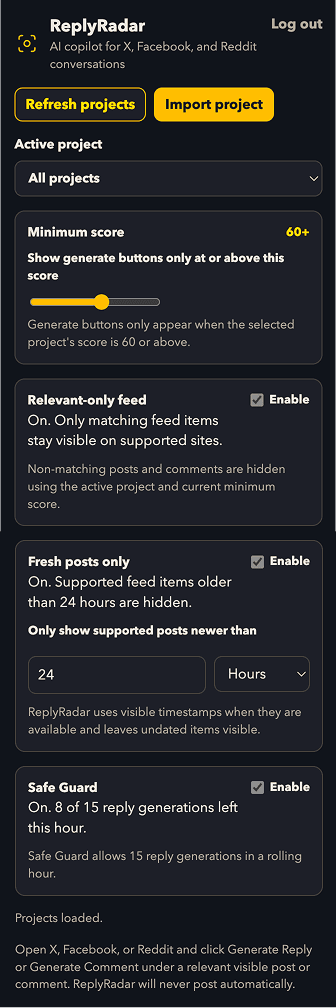
ReplyRadar keeps discovery, qualification, and reply drafting close to the live Reddit or X conversation instead of hiding the work in a generic dashboard.
Teams can review fit signals, discussion context, and reply angles before deciding whether the conversation is worth joining.
A lot of confusion comes from using the same words for two different operating models. This page separates them so buyers can decide what they really need.
Best for broad mention monitoring, sentiment tracking, reporting, and category awareness across many channels or stakeholders.
Best for recommendation requests, alternative searches, switch signals, complaint-heavy threads, and evaluation language that already points toward revenue.
Both workflows watch public conversations. The difference is whether the team values total coverage or commercial selectivity more.
Choosing the wrong category usually creates either noise or blind spots. The right answer depends on the team, the workflow, and the action the conversation is supposed to support.
You need broader monitoring, campaign visibility, reporting, or cross-channel awareness that extends beyond active buyer evaluation.
You care more about recommendation requests, switch pressure, competitor complaints, and the kinds of public conversations that can become pipeline or sharper positioning.
Some teams need a broader listening layer and a tighter commercial signal layer. Small teams usually should not buy both unless they know who owns each workflow.
ReplyRadar is strongest when the team wants fewer, higher-signal threads and a review-first workflow built around action rather than passive monitoring volume.
Track the posts where buyers ask what to use, what to replace, or how to choose instead of relying only on broad mention coverage.
Use public frustration, alternatives research, and timing language to understand not just what was mentioned, but why the conversation matters now.
ReplyRadar helps qualify the thread and preserve context before the team decides whether the conversation should feed research, a reply, or a new page.
Sometimes, but not always. It can be implemented inside a broader listening stack, yet the workflow, query design, and success criteria are distinct enough that many teams should treat it as its own job.
Buyer-intent monitoring is usually the better first investment because the team needs a smaller set of commercially useful conversations more than broad reporting coverage.
ReplyRadar sits on the buyer-intent side. It is built for recommendation requests, public evaluation language, competitor complaints, and review-first engagement instead of broad awareness monitoring.
Track public demand signals across Reddit and X before the buyer fills out a form or talks to a competitor.
Learn how to recognize and qualify social conversations that reveal active evaluation, pain, or recommendation intent.
Own the moments when buyers ask what they should use, replace, or switch to next.
Compare broad brand monitoring with a leaner system built for founders chasing high-intent public demand.
Compare alert-driven monitoring with a platform that helps teams qualify and act on the best threads manually.
See when a broad listening suite is overkill and when a founder-focused buying-intent workflow is the sharper tool.
See how ReplyRadar ranks recommendation posts, competitor complaints, and workflow pain against your positioning.
Understand the scoring layer behind the Reddit conversation discovery workflow.
Browse public ReplyRadar projects to see how different products frame their audience, pain points, and competitors.
Track Reddit conversations where teams compare project management tools, complain about process sprawl, or ask what to switch to next.
Surface recommendation requests, cost complaints, and migration discussions around CRM software across Reddit.
Find a post-GummySearch replacement built for live buying-intent discovery and manual engagement.
Use ReplyRadar to monitor Reddit and X for recommendation requests, competitor complaints, and real workflow pain points that deserve a thoughtful reply.