Complaints reveal switching pressure early
Buyers often explain what is broken before they say they are leaving, which gives founders a stronger lead time than waiting for explicit alternative searches.
Discover competitor complaints early enough to catch churn-risk language, switching pressure, and the proof gaps buyers expose before they actively choose a replacement.
Competitor complaints are valuable because they rarely stay isolated. They often become recommendation requests, shortlist discussions, or internal churn concerns a few days later. Catching them early helps founders shape positioning, comparisons, and retention-aware outreach before the conversation hardens.
Buyers often explain what is broken before they say they are leaving, which gives founders a stronger lead time than waiting for explicit alternative searches.
Complaint threads can strengthen comparison pages, objection handling, onboarding copy, and retention-focused messaging at the same time.
Pricing friction, setup drag, reporting distrust, and missing context tend to create stronger switching motion than vague dissatisfaction.
Founders can review why the complaint matters instead of seeing a flat list of competitor mentions with no commercial signal attached.
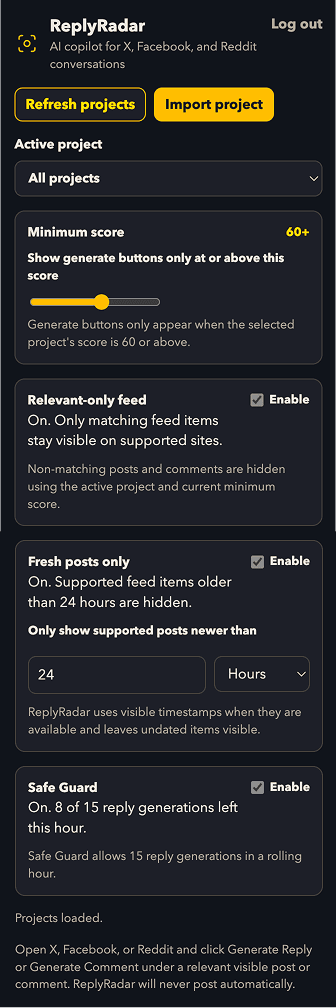
ReplyRadar keeps discovery, qualification, and reply drafting close to the live Reddit or X conversation instead of hiding the work in a generic dashboard.
Teams can review fit signals, discussion context, and reply angles before deciding whether the conversation is worth joining.
A public complaint can act as an early-warning system for switching intent. The buyer may still be testing workarounds, but the thread already exposes what proof they need and what they no longer trust.
Reporting confusion, missed alerts, or clumsy handoffs often create the complaint before the buyer frames it as a formal replacement search.
Budget frustration, timeline language, and comparisons to a leaner workflow usually hint that the buyer is closer to a switch than the headline suggests.
Complaint threads often use the exact words future customers will use when they explain why the incumbent no longer fits.
The goal is not to collect every negative mention. The goal is to prioritize the complaints that look likely to turn into a switch, a recommendation request, or a sharper comparison question.
When buyers say a tool is too expensive for what it delivers, the conversation is often already drifting toward alternatives and proof comparisons.
Heavy implementation, weak filtering, or too much manual cleanup usually produces both dissatisfaction and a clearer appetite for something leaner.
Buyers complain most when the system still leaves them doing interpretation work after promising to simplify the workflow.
ReplyRadar is built to keep complaint-heavy conversations tied to urgency, fit, and next-step judgment so founders can use them for demand capture and sharper positioning before the window closes.
The product helps connect public frustration to the moments when buyers ask what to use next, which makes the workflow more commercially useful.
A strong complaint might feed a comparison page, a saved search, a founder reply, or a retention-focused proof section depending on the conversation.
Founders can focus on the complaints that imply real movement instead of reading every generic mention of an incumbent.
Because the complaint usually reveals the failure mode and replacement criteria earlier than a direct alternatives search. That gives you more time to shape positioning and identify useful switching conversations.
Complaints tied to pricing value, heavy setup, missing context, weak prioritization, or unreliable reporting tend to create the strongest switching pressure.
ReplyRadar helps founders monitor complaint-heavy conversations with context, score the signal against fit and urgency, and route the best threads into comparisons, saved searches, or selective engagement.
Start with the evergreen cluster for buying intent, recommendation monitoring, and high-intent conversation discovery.
Browse the public tool hub for lighter acquisition workflows around social listening, buying intent, and conversation review.
Review the product terms if your team wants clarity on account usage before rolling out a new monitoring workflow.
Compare broad brand monitoring with a leaner system built for founders chasing high-intent public demand.
See when a broad listening suite is overkill and when a founder-focused buying-intent workflow is the sharper tool.
Compare alert-driven monitoring with a platform that helps teams qualify and act on the best threads manually.
Learn how to recognize and qualify social conversations that reveal active evaluation, pain, or recommendation intent.
Focus on recommendation language, switching behavior, workflow complaints, and named competitors instead of vanity mentions.
Use public recommendation requests to spot early adopters who are already explaining what they want, what they reject, and why timing matters.
See how ReplyRadar ranks recommendation posts, competitor complaints, and workflow pain against your positioning.
Understand the scoring layer behind the Reddit conversation discovery workflow.
Browse public ReplyRadar projects to see how different products frame their audience, pain points, and competitors.
Use ReplyRadar to monitor Reddit and X for recommendation requests, competitor complaints, and real workflow pain points that deserve a thoughtful reply.